
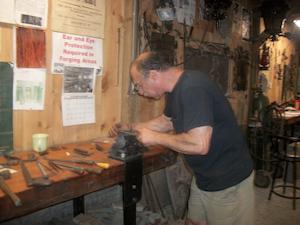
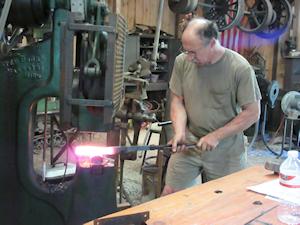
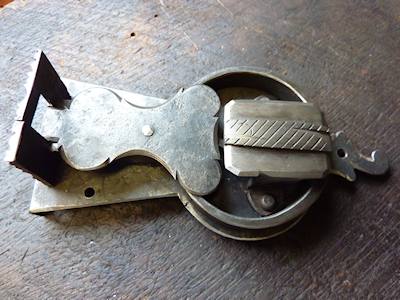
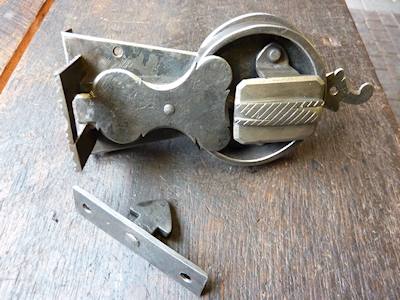
Students will make a "Crab" lock based on an antique example originally made in Pennsylvania just
after the Revolutionary war.
This type was typically used inside a blanket chest with hinged lid. The lock involves a number of
processes and uses a variety
of skills and offers the opportunity for a variety of decoration and embellishment.
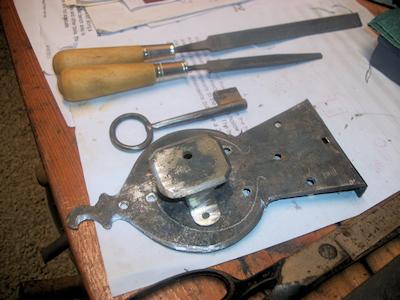
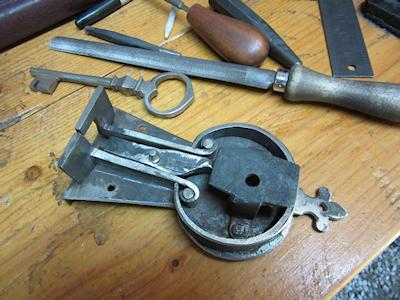
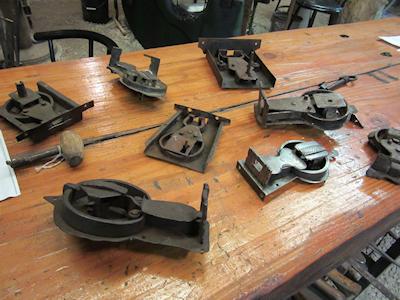
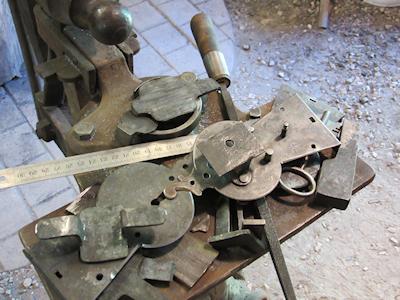
Starting with a finished key (either made by each student in advance or provided at the beginning
of class), we will cover the
basic layout, warding systems, making the parts, fitting, assembly and final tuning. This will involve
forging the moving parts,
including the spring, filing and fitting, and the common methods of hand production and assembling.
Students will also be expected
to make their own small punches and other simple tools.
The emphasis will be on historic methods (simple hand tools) in both the forging and bench skills.
We will also cover typical file
decoration typically used in the late 18th century. Students should expect to spend more time at the
bench than at the anvil on this project.
Those who choose may use wrought iron.

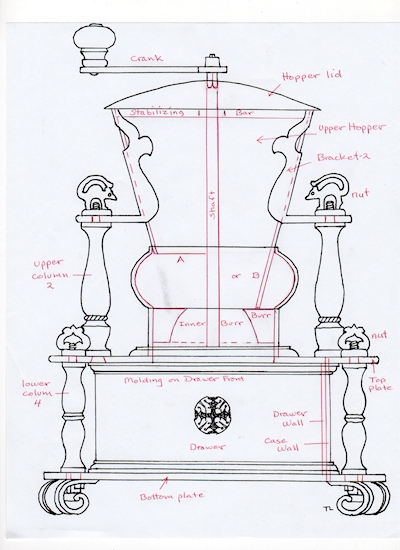
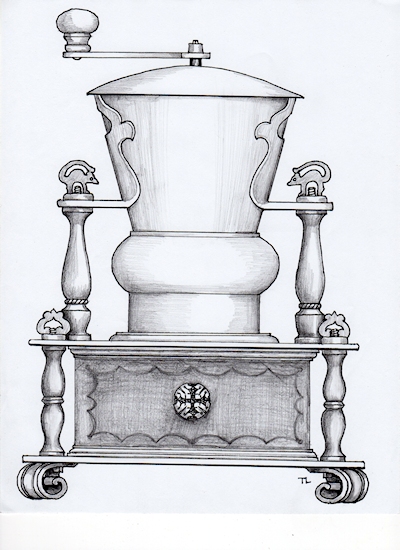
This class will be a "make-up" session for the construction of a
coffee mill similar to the one the Patient Order of Meticulous Metalsmiths made at the
2014 ABANA conference.
In the first session students forged the conical steel burrs
and started filing the teeth (to be completed at home). The rest of the session
was spent forming the upper hopper for receiving the beans and the burr housing.
These forms will be constructed out of heavy sheet brazed in the forge.
Brackets to support the hopper and center the crank shaft will be forged and riveted
to the vessel.
In the second session the steel burrs were case hardened and the drawer for the grounds
formed along with its housing. The lower support for the central shaft was forged along
with the parts for adjusting the coarseness of the grind. Decorative embellishments were
demonstrated including swaging moldings, chasing the knob, and raising beads in the sheet metal
surface with a fine fuller.

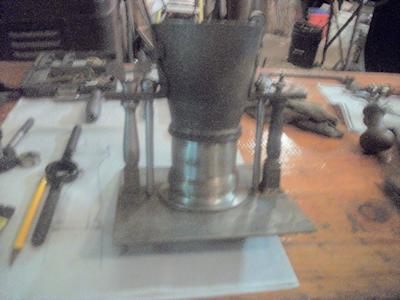
The last session will cover forging the columns that join the parts , the feet , and the crank . The columns may be round, square, hexagonal, or octagonal, twisted or straight. Assembly will be with threaded tenons and nuts, permanently peined tenons and wedges.

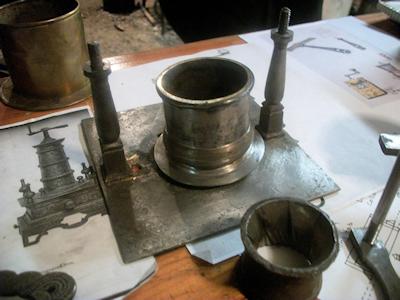
Tom had to make a special fixture to facilitate brazing the cone. Here are two pictures of the fixture and Tom's comments about it:
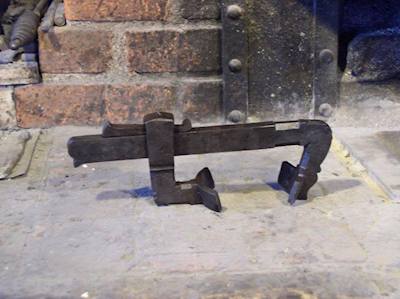
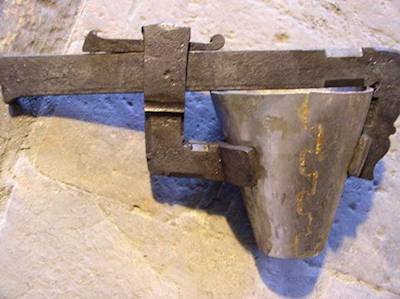
"I made this tool because no clamp I had would pinch the joint together in the cone shaped hopper for the coffee mill the
Patient Order of Meticulous Metalsmiths is making at the ABANA conference.
The clamp was made to pinch the joint together before beating down the dovetail overlap. The clamp is heavy enough
to put into the fire while brazing the joint."

Here is the completed prototype Hopper
Directions to Tunnel Mill: Tunnel Mill is located 20 miles south of Rochester. Take Hwy 63 out of Rochester to Stewartville, turn east on Hwy 30 to County Rd 1 (approx 5.5 miles).
Turn south on County Rd1 Follow CO RD 1 6.5 miles to Tunnel Mill on the left side of CO RD
Call about camping on the grounds. 507-378-4983 or 507-289-4189, John or Carol.
Lodging available in Spring Valley, 5 miles further south on CO RD 1.
Shady Rest 507-346-2625---Spring Valley Motel & Suites-507-346-7788
For more information on any of the classes contact us at
jc-adams@msn.com, or call 507-289-4189 John or Carol Adams.
We are located in southern Minnesota. Tunnel Mill was an old water powered mill. Built in 1869.
Retired in the late 1920's..
Located on the Bear River north of Spring Valley, MN.
Wooded 50 acres with a stream that runs through it.
Now, it's a place for crafts people and friends to congregate, relax and learn some of our forgotten crafts.
Watch for more classes!!