John Adams Memorial Tree Planting Day- May 12, 2018
Carol Adams of Tunnel Mill cordially invites
everyone to come down to the mill for a special tree planting day on Saturday, May 12, weather permitting.
Carol will have BBQs and chips available for all. Bring something to share if you'd like.
Be sure to dress appropriately, and bring tools that can be used for planting small
trees.
Please call Carol at 507-289-4189 before 5 pm weekdays, or email her at
jc-adams@msn.com
to let her know if you can make it.
If you call on Friday, May 11, after 7 pm, call her Tunnel
Mill phone at 507-378-4983.
Note: There is still one opening in the Peter Ross Class!
Call Now to reserve your spot: Contact Carol at 507-289-4189
Bread Oven Class: June 9
Bench Vise, Part 2
Tom Latane'
Class is full
May 4, 5, & 6 2018
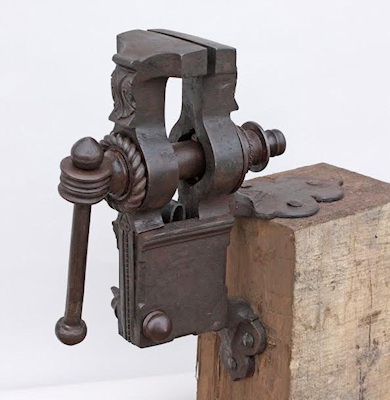
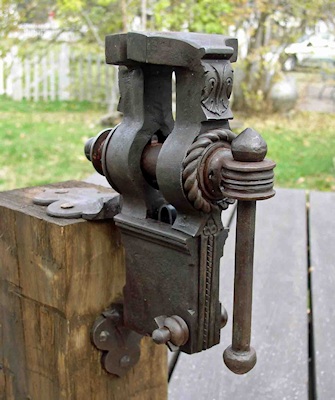
Students continue work on a bench vise with three inch wide jaws.
Review of the process:
Striking for each other, they will upset the stock for both jaws and weld high carbon steel on each.
Once the jaws are forged, an eye will be split and drifted below each for the screw and box.
The bench mount will be forged with a tenon to pass through the rear leg below the eye. This tenon will also hold the spring in place.
The bottom bracket may be forged as a plate to be fastened to a bench leg, or tapped to take a screw for clamping to the bench.
A swage for producing molding on the upper edges of the cheeks will be demonstrated as an option. Cheeks will be riveted and welded or brazed in place.
Making threads on the screw will not be part of the class.
The screw shaft can be forged with an eye on the end for a toggle and threads
cut on a lathe later.
As an alternative students may forge the eye and fit it to a tenon filed on a salvaged screw from a "C" clamp,
as was done for the prototype.
The components for the box will be forged and brazed around a salvaged nut or around a worm wound on the screw.
Peter Ross
One Spot Still Available
Peter will teach Two 3-day classes:
May 14, 15, 16, 2018 -Tools. May 18, 19, 21, 2018- Hinges
Peter's interest in early ironwork developed accidentally as the result
of part time employment at a local living history museum. He spent weekends
and summers working in the blacksmith shop, watching the pieces he had just made
be put to use in correct historic context. After attending the Rhode Island School of Design and a year studying
with blacksmith/whitesmith Dick Everett in East Haddam, CT, he opened his own shop.
In 1979 Peter was hired as a journeyman blacksmith by the Colonial Williamsburg Foundation.
Two years later he took over the shop as Master; a position he held for 23 years.
In addition to reproducing hundreds of different pieces of 18th century hardware, utensils, tools, etc,
Peter and staff helped re-discover pre-industrial methods long out of use.
For the last 30 years, he has been a frequent demonstrator at ABANA national blacksmith conferences,
given hundreds of classes and workshops on historic tools and methods at prominent Craft schools,
regional blacksmith conferences, and museum sites.
Peter now operates his own business in Siler City, North Carolina making museum quality reproductions of 18th and 19th
century hardware.
Recent projects include the hardware for the distillery at Mount Vernon, door locks for Monticello
and Montpelier, and other private restorations.
May 14, 15, 16, 2018 -Tools
This first session will cover hand tools, such as socket chisels, draw knife or other hand tools
HE THAT WILL A GOOD EDGE WIN
Two basic woodworking tools form the basis for this class- a. socket chisel and a
drawknife. Both are excellent examples of hand tools that can be made in a small
traditional smith shop. Starting with antique examples as inspiration, we wi11 tackle
both tools in the manner of the originals. This includes forge welding steel edges to
softer tool bodies, forging to shape, heat treating, grinding and finishing to the level
seen on tile examples. Both tools arc a healthy challenge in anvil work, using basic
forging skills. The chisel sockets are forge welded, drawknives involve upsetting
corners. There will be plenty of challenge for all levels of student skills.
This is an excellent opportunity to work with wrought iron for the tool bodies, and
learn about its pros and cons. Students are welcome to bring iron with them or
arrange in advance to have some available during class. Otherwise, mild steel can be
used.
May 18, 19, 21, 2018- Hinges
This second session will concentrate on hinges.
The fringe element may cringe, but this hinge binge will Not impinge on any modern
sensibilites. Applying a tinge of historic precedent, a. twinge of tradition, and
hopefully no singed fingers, we will tackle two varied approaches to making hinges.
The first will be small furniture grade hinges with forge welded eyes, fitted, assembled,
and decorated at the bench. Filed decoration and finishing will he an important
aspect, and will covered carefully. The second approach will be a larger hinge
suitable for doors, made almost entirely at the anvil. Eyes for these hinges can be
rolled or welded. Two historic approaches to making the pintles will be covered as
well. As usual in my classes, hand tool use and traditional hand skills will be
emphasized, and historic examples used as inspiration for the projects.
Tired of dingy hinges- this class will brighten them up!
Master of Repouse and Chasing
Douglas Pryor
Class is full
June 1, 2, 3, 2018
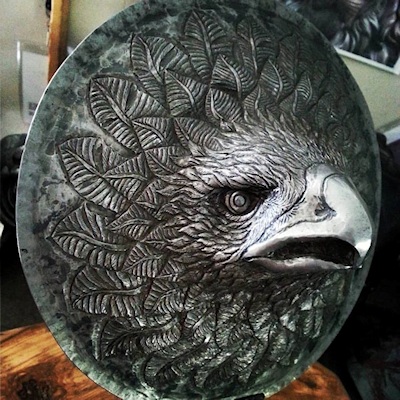
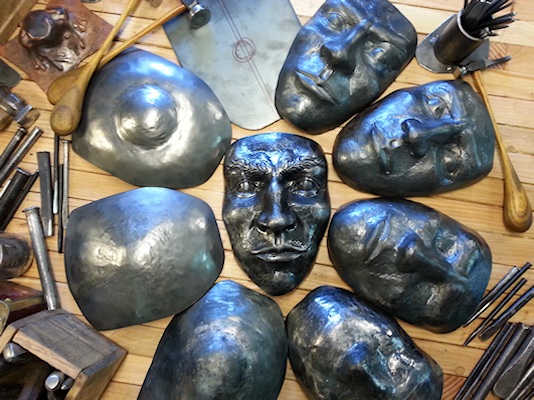
Class description for Douglas Pryor:
In this 3 day workshop we'll be exploring the plasticity of sheet metal (copper and steel) through
material appropriation using raising and chasing. This method is designed to keep the relative thickness
of the material consistent to the original thickness, allowing the chaser to save material for sculpture
and dramatic undercuts without losing the inherent strength of the material. There are a few
projects for us to pick from. They are intentionally designed by Douglas to guide us through beginner
and advanced art styles in sheet metals in this method.
This time, Doug will also be catering to the advanced needs of students who took the class last year.
All tooling is provided! All experience levels are
welcome! All you need to bring is your curious mind!
Artist bio:
Douglas got his start in sheet metal forming through armour smithing in 2006. As a teenager too poor to
buy the equipment needed to compete in full contact sword fighting he began to make his own ... and all
his friends, and then some. After taking all of the welding and metal art classes through sierra college
he became more and more curious on how to make things without using welding. So the exploration
through "raising" metals began. This was very beneficial as it opened up many new options for creating
more complex and sophisticated works, though it would take much practice. In 2012 the introduction of
working in pitch greatly increased and challenged the way Douglas approached metal working.
The ability to fill works made of sheet metal with pitch, allowing the hollow metal to behave closer to a
flexible solid greatly enhanced what is achievable. The complementary nature of raising and chasing
has completely captured Douglas' imagination and now he hopes to explore the joys of chasing with you!
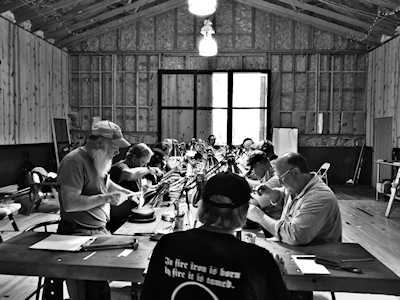
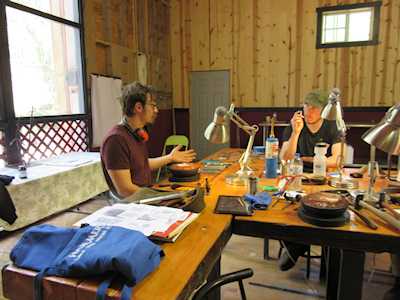
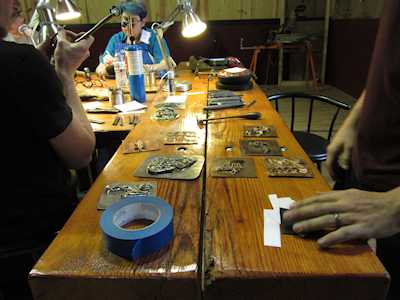
Here are some pictures of the class in session:


See some of his work for yourself here at:
Douglas Pryor's Website
Douglas Pryor at Facebook
Douglas Pryor at Instagram
Jeff Wagenaar, Recent "Forged In Fire" Winner
Jeff will teach his methods of producing Damascus Blades
August 11 and 12, 2018
Make Damascus (layered steel)
Ric Furrer-Door County Blacksmith
August 17, 18, and 19, 2018
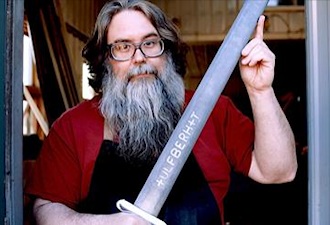
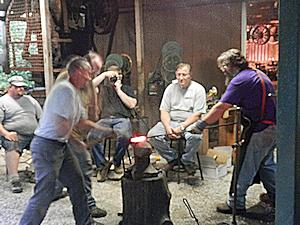
We have been fortunate to be able to host Rick Furrer for the past few years and look forward to hosting him again in August of 2018.
-----------------------------------------------------------
Rick says:
For a change of pace this year we will all make the same style of knife. The idea being that you all leave with a completed knife.
In the past there was less structure and as a result some knives were left unfinished.
This slab handle pattern-welded knife with 5" blade lanyard hole will cut well and look good doing it.

No monster machete/sword/dagger/short sword blades allowed.... there simply is not enough time.
This fast paced class will take your from initial welding of a stack of steel through rough forging, rough grinding,
heat treating, final grinding and gluing on the wood handle.
We will use gas and coal forges and liberal amounts of grinding. I will help with the tricky bits.
One of the evenings I will weld up a large pattern-welded billet under the big hammer.
---------------------------------------------------------------------------------------
Here's just a recap on what Rick has done previouly;
-We have created the damascus steel of the early eastern world.

-Some attention was paid to Wootz Crucible steel and it will be a continuing part of his upcoming workshop.
Wootz is the steel used in many of the famous Persian and Indian sword blades and research into its creation
spawned the field of Microscopy in Europe.
-With the steel you make, you can make a tool of your choice, (Send blue prints to us prior to class) a chisel, gouge, or cutting edge tool.
-------------------------------------------------
Some images from Ric's 2017 Class:
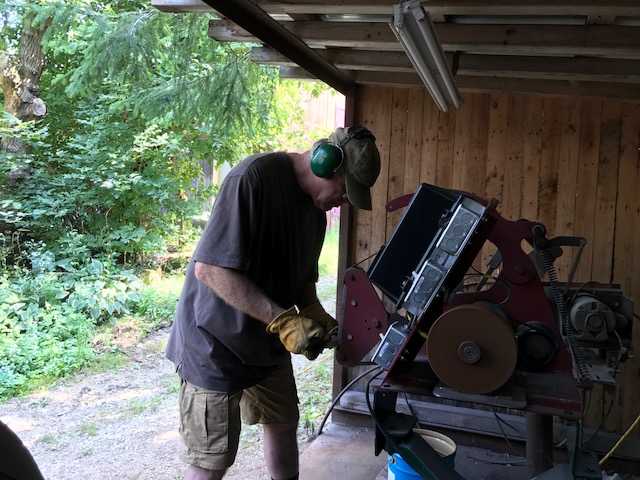
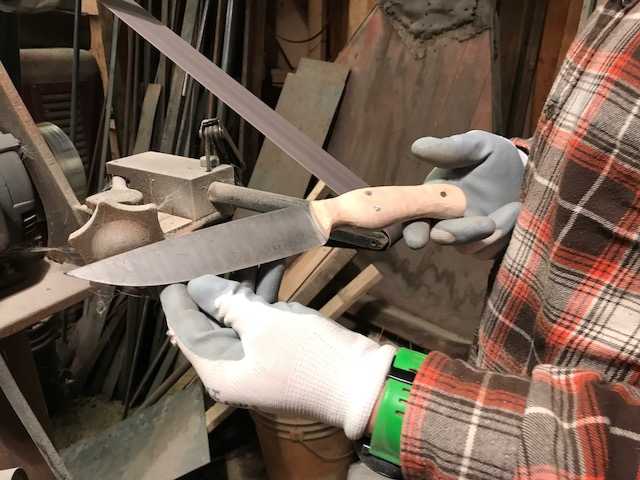


Ric Furrer 2017 Tunnel Mill Class Picture
We have and will continue using the $500# Little Giant Hammer.
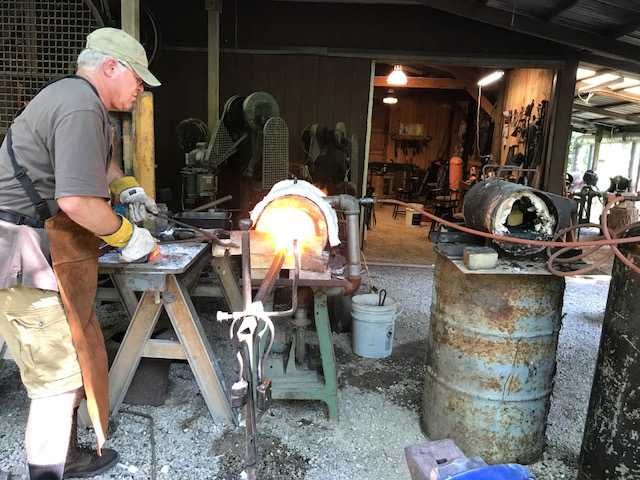


Work for the 500 Pound Little Giant Power Hammer
Check out Ric Furrer at http://www.doorcountyforgeworks.com/
Watch the video at http://www.youtube.com/user/RicFurrer
Mill Gathering
October 5, 6, 7, 2018
Tom Latane'
Hack Saw class
October 12, 13 & 14, 2018
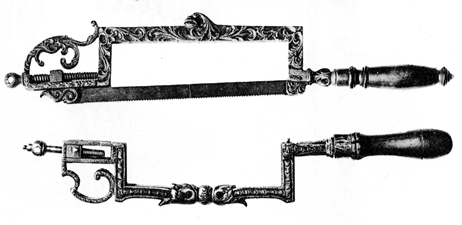
Students will construct a hacksaw based on seventeenth century examples.
This style has a rack at the end opposite the handle, in which a carriage, made to take the blade
laid vertically or horizontally, is moved by a screw to supply tension. The rack will be stabilized by a scroll or acanthus leaf.
Parts will be forged, filed and chased. Some parts will be brazed in the forge.
Decorative techniques demonstrated will include piercing, chasing in solid material, and filing.
Participants may prepare wooden handles prior to the class or make them to fit later. I may bring some turnings to sell.
Directions to Tunnel Mill: Tunnel Mill is located 20 miles south of Rochester. Take Hwy 63 out of Rochester to Stewartville, turn east on Hwy 30 to County Highway 1 (approx 5.5 miles).
Turn south on County Highway 1. Follow CO HWY 1 6.5 miles to Tunnel Mill on the left side of CO RD
Call about camping on the grounds. 507-378-4983 or 507-289-4189, Carol Adams.
Lodging available in Spring Valley, 5 miles further south on CO RD 1.
Shady Rest 507-346-2625---Spring Valley Motel & Suites-507-346-7788
Class Registration Form
Class Contact Information
For more information on any of the classes contact us at
jc-adams@msn.com, or call 507-289-4189 Carol Adams.
We are located in southern Minnesota. Tunnel Mill was an old water powered mill. Built in 1869.
Retired in the late 1920's..
Located on the Bear River north of Spring Valley, MN.
Wooded 50 acres with a stream that runs through it.
Now, it's a place for crafts people and friends to congregate, relax and learn some of our forgotten crafts.
Watch for more classes!!
